

Categories
blog Sustainable Gardening Basics

FAQs: What is the fuss about exotic plants?

If an exotic or non-native plant is introduced in a new country / region, it may thrive equally well like the locals. However, it comes at a cost. Both for you and our environment.

Exotic plants affect the ecological functions in several ways.

Outnumber natives

To survive, exotic plants multiply at a much faster rate than native plants. In the long run, such exotic plants become invasive and push the native plants into extinction.

Degrade soil quality

In the race of survival, exotics end up consuming more nutrients present in the soil. Slowly and gradually, this process deprives native plants of basic nutrition to grow.

Reduce foliage area

Leaf canopy or structure of such plants is usually thin, fragile. Exotic trees such as pine don't let other plants to grow besides them, thus, reducing the green foliage area.

Induce pest attacks

One of the common problems with exotic plantation is frequent pest attacks. Native plants have the immunity to fight known and unknown pests as compared to exotics.

Bring new diseases

Plants from different countries may carry along certain organisms and viruses. Such scenarios can give birth to new diseases among plants on a foreign soil.

A simple observation related to the movement and settlement of birds can give us an idea of this impact.

For instance, birds use their intelligence to recognize exotic trees and avoid building their nests on them in the absence of an alternative. (non-native or exotic trees are weaker in the rooting system as compared to the native trees and are more prone to falling).

On the other hand, invasion, predation of birds is higher when they settle down on exotic trees v/s native, displacing species and eventually leading to their extinction.

Exotic plants are not bad by themselves. They are just plants after all, but happen to be in a different place, unknown environment, and more often bring along a host of issues. The human endeavor to introduce and multiply exotic plants in non-native conditions creates a negative impact on the local ecology.

Categories
blog Sustainability

A full circle

Lately, I have developed a new fetish for terracotta. One product, in particular, fascinates me the most — teacups, infamously known in India as kulhad.

Suddenly, the world is going gaga over this good old product. Evicted for convenience-based alternatives over the years, the humble clay is finding its way back into the plastic culture as a sustainable solution. Today, these teacups not only come in all sizes and shapes but also with tags such as ‘Luxurious’, ‘Food Safe’, ‘EU-approved’ et al.

Until two decades ago, if someone (from the East) promoted terracotta, yoga, Ayurveda or Sanskrit in the West, then judgements would have been passed, inferences would have been made, and conclusions would have been drawn. How can such primitive concepts emanating from a socio-economically backward and developing nation be relevant to the modern needs of the technologically progressive, developed world?

Cut to 2020. In the USA alone, demand for yoga practitioners was estimated to be 55 million according to global statistics. Germany has the highest number of Sanskrit scholars outside of India and each year, the commitment to learning the language is deepening.

But why would an advanced nation with the highest political and economic position embrace such ancient scriptures and practices from a lesser developed one?

Let’s explore this conjecture with an example — agriculture.

What started in 1850s as the Agricultural Revolution, then extending into the Great Divergence of the 19th century, provides an insight into the symbiotic relationship between technology and policymaking.

Dwight D. Eisenhower, the 34th President of the United States, drew this parallel in his annual speech on January 05, 1956. Excerpts:

“We have a broad and diversified mobilization base. We have the facilities, materials, skills and knowledge rapidly to expand the production of things we need for our defense whenever they are required. But mobilization base requirements change with changing technology and strategy.”

“No other resource is so indispensable as the land that feeds and clothes us. No group is more fundamental to our national life than our farmers.”

With the introduction of technologically advanced, scientifically proven, commercially viable and convenience friendly sanitary napkins, India’s women were finally set ‘free’ by ‘progressive’ solutions invented in the West.

“The dimensions of government responsibility are as broad and complex as the farm problem itself. We are here concerned not only with our essential continuing supplies of food and fiber, but also with a way of life. Both are indispensable to the well-being and strength of the nation.”

“This is still true in this era when improved living standards and rising national requirements are accompanied by swift advances in technology and rapid obsolescence in machines and methods.”

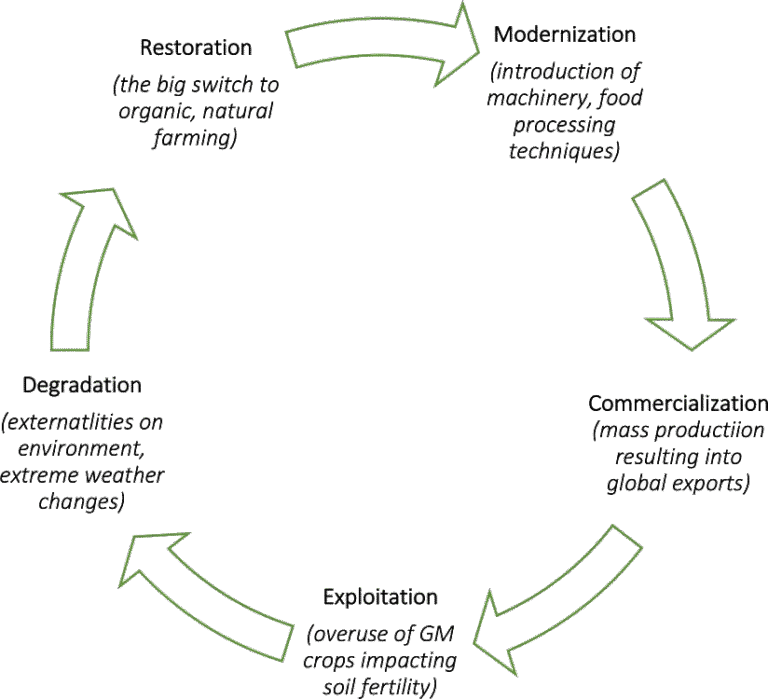
Against the backdrop of post-World War II, American agriculture was reeling under a unique challenge — unpredictable yields, harsh weather conditions and declining farm income. Technology advances in the US such as hybrid farming, chemical fertilizers and pesticides and biotechnology changed the face of agriculture by enabling increased farm productivity, reliable and higher yields and sustained profitability. Policy measures, on the other hand, facilitated a launchpad for corporations such as Monsanto, DuPont to propel commercialization and gain market power in international trade. This period marked the golden era in the West’s modern history with its meteoric rise as a global superpower.

Everything was hunky-dory until the fog around this fast-paced evolution began to dissipate, the externalities came to the surface and the circle of life started to evidently appear.

This progress came at a colossal loss to the West — the soil, plants, cattle, birds, bees, water, air, clouds, and of course, humans — each element experienced the brutality of modern science and technology. What seemed like an innovative solution for securing food safety, now appeared as a disservice to nature and counterproductive to human survival.

At this juncture, the West met the East.

Ancient practices such as organic farming — a concept borrowed from the developing world, were promoted by governments and celebrated by policymakers as a human and environmental welfare agenda.

Government initiatives such as the 2014 Farm Act facilitated the cost of organic certification (among other aspects) for farmers while the recent $867 billion farm bill introduced in 2018 funded organic farming research.

The outcomes of these policies reflected in the adoption of the organic technologies widely and commercially.

A recent survey conducted by the Census of Agriculture revealed that number of certified organic farm in the U.S. increased by 17% and sales by 31% between 2016 and 2019, touching an all-time high in sales of $9.9 billion in 2019 alone.

Today, chemical-free food produce dominates US markets, vegetarian lifestyle is widely adopted, cold-pressed juices are being preferred over processed, eco-friendly way of living is the new theme and the list continues.

Today, chemical-free food produce dominates US markets, vegetarian lifestyle is widely adopted, cold-pressed juices are being preferred over processed, eco-friendly way of living is the new theme and the list continues.

As the West continues its quest to negate manmade disasters, the East is realizing the hazardous impact of banishing its native practices under the influence of foreign ‘success’.

There were striking similarities between the challenges these two agrarian economies (the US and India) faced — from declining farmer income, farmer suicides to harsh weather conditions. Such relatable conditions and subsequent innovations would have made the ‘progress’ story more believable. However, the dissimilarities between the policymaking and governance of these nations had far-reaching impact on the latter considering its size of population and disproportionate social justice systems.

Repercussions of injecting genetically modified crops, fertilizers and chemicals, intensive irrigation methods into the natural habitat must have been felt by the government’s in the East when the sun started rising in the West and it outshined the world. And then began the journey of reversing the sun’s transition to the East and reclaiming its position.

With this new realization developing nations, such as India, are marching ahead in the race of organic produce. At the back of government’s incentive programmes in the last decade that encourage farmers, startups, entrepreneurs, corporations to adopt the good old habits right from growing food to maintaining holistic health naturally, India is the highest contribution of organic producers globally today.

The East, a land of traditions, cultures, values, ingenious inventions has learnt a lesson the hard way. By going back to its roots, embracing ancient practices and applying tried-n-tested knowledge, the East can now comfortably claim — we have seen life coming to full circle.