
Categories
blog Sustainable Gardening Basics

The Times of India: Can a balcony garden actually reduce indoor heat? Here’s what science says

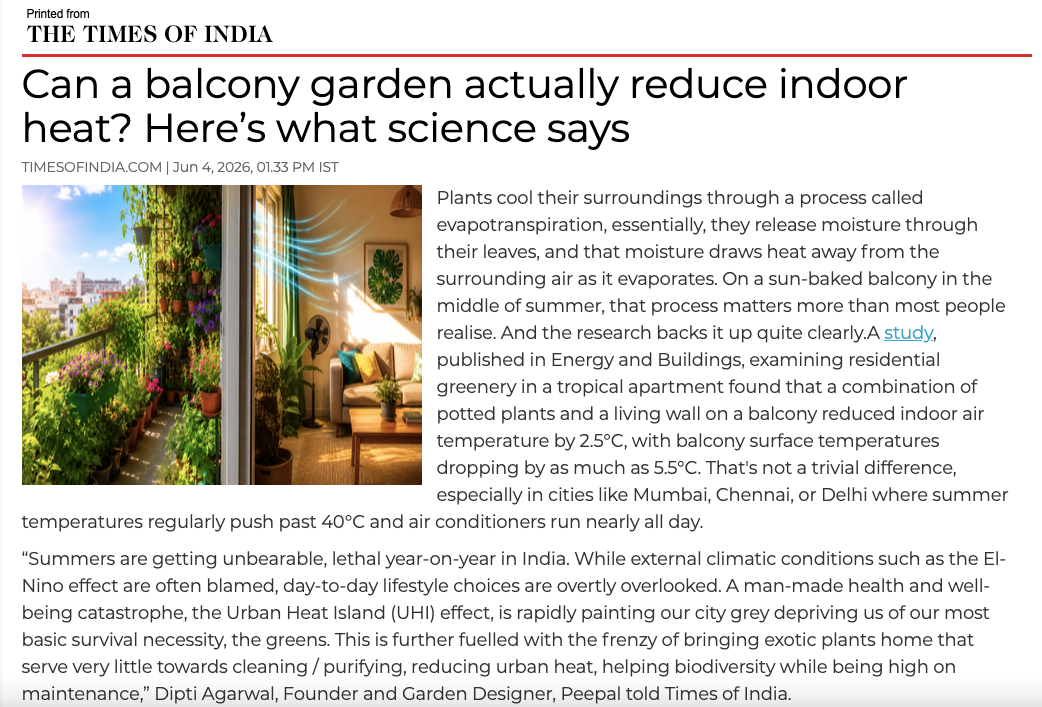
Plants cool their surroundings through a process called evapotranspiration, essentially, they release moisture through their leaves, and that moisture draws heat away from the surrounding air as it evaporates. On a sun-baked balcony in the middle of summer, that process matters more than most people realise. And the research backs it up quite clearly.

study, published in Energy and Buildings, examining residential greenery in a tropical apartment found that a combination of potted plants and a living wall on a balcony reduced indoor air temperature by 2.5°C, with balcony surface temperatures dropping by as much as 5.5°C. That’s not a trivial difference, especially in cities like Mumbai, Chennai, or Delhi where summer temperatures regularly push past 40°C and air conditioners run nearly all day.

“Summers are getting unbearable, lethal year-on-year in India. While external climatic conditions such as the El-Nino effect are often blamed, day-to-day lifestyle choices are overtly overlooked. A man-made health and well-being catastrophe, the Urban Heat Island (UHI) effect, is rapidly painting our city grey depriving us of our most basic survival necessity, the greens. This is further fuelled with the frenzy of bringing exotic plants home that serve very little towards cleaning / purifying, reducing urban heat, helping biodiversity while being high on maintenance,” Dipti Agarwal, Founder and Garden Designer, Peepal told Times of India.

Tackling this issue at a city’s infrastructure level is a gargantuan task but, one can address this issue with smart and sustainable greening efforts at their disposal, home gardens, she adds.

For Indian homes specifically, the evidence is encouraging. A study in Greater Noida found that terrace gardens can reduce ceiling temperature by 2°C to 3°C in winter and 5°C to 7°C in summer.

Agarwal says native and hardy species create a quick, thick green cover of leaves and provide a cooling effect. “Popular exotic plant choices such as Bougainvilleas are often opted in home gardens. However, one must distinguish plants that are heat-resistance with plants that can reduce heat in the environment. Bougainvilleas, while being globally-loved, often fail to maintain a thick, green look with their small and scanty leaves, thus being counter-productive for reducing urban heat,” she suggests.

The expert shares few guidelines on this:
 
  • Choosing the right species of plants that provide shade with their canopies, cool and purify air with their large leaf structures or create a natural green curtain can go a long way in reducing urban heat.
  • Simple garden design elements such as a trellis for balconies or terraces can help create a natural green wall or a vertical garden coupled with fast-growing climbing plants such as Thunbergia Grandiflora, Madhumalti (Combretum indicum), Aparjita (Clitoria ternatea), Chameli (Jasminum officinale), etc.
  • Another effective technique is layered plantation that uses different plant height combinations in descending order. Much like forests, this cascading effect helps in creating overlapping canopies and filtering sunlight before it reaches the bottom. For example, one could pair a tall palm or Champa plant with medium flowering shrubs like Ixoras or Jasmines to create a layer of visual and heat relief.
 

What practical advice would you give homeowners or apartment residents who want to create a balcony garden specifically to combat indoor heat during summer?

“Opting for native plants that have broad leaf structure, deep root systems, dark green foliage colour, can help cool the environment through evapotranspiration process. Releasing moisture, increasing air flow, blocking sun rays, thus reducing internal temperature are just a few of the several benefits of creating a well-planned balcony garden,” she suggests. “The wider leafy surface area you can add to your garden space, the better cooling effect you eventually create. At an individual home level, this cooling effect can be gradually felt with the right plant mix and low-maintenance gardening materials to maintain the garden’s health and look.”

Few examples:

For balconies, says the founder, decks or terraces that receive direct sunlight, exotic foliage plants should bereplaced with native flowering plants. Few examples of medium heighted shrubs include Ixora (Ixora coccinea),Son Champa (Magnolia champaca), Nag Champa (Plumeria Pudica), Parijat (Nyctanthes arbor-tristis), Hibiscus(Hibiscus rosa-sinensis), Kaner (Nerium Oleander) among others. Even edible plants like Lemons, Curry Leaves,which tend to have thick foliage could serve the purpose. Such plants not only help elevate your internalenvironment but also support biodiversity. On the other hand, for spaces which receive partial direct sunlight(indirect bright light), one can opt for palms (although most of them are non-native) for Areca Palm (Dypsislutescens), Rhapis Palm (Rhapis excelsa), and Ficus varieties.

So yes, a balcony garden can genuinely reduce indoor heat. It won’t replace an air conditioner on a 45°C afternoon. But it will take the edge off, cut your cooling load, and make your home more liveable through summer. Plants that you grow anyway, doing something useful all day long. 

Categories
blog Sustainable Gardening Basics

5 reasons why you need a sustainable landscape

We are surrounded with landscapes in our everyday life – be it backyards, balconies, parks, public green spaces, roads, and even office spaces.

Using sustainable practices in your garden, no matter where you live – whether you create a garden in a balcony, your housing society or farmhouse, can do good for you and our environment. Sustainable landscapes enhance our environment’s ability to clean air and water, reduce flooding, combat climate change, and provide all the other natural benefits that support life on earth. Sounds big?! Let’s break it down in simple words.

A sustainable landscape works with nature, not against it. Irrespective of its size, it maximizes environmental and health benefits for the current and future generations. In short, a sustainable landscape is a beautiful garden that protects or restores the benefits nature provides us that are essential to our everyday lives. It can be a space for outdoor recreation, gathering with family and friends, stormwater mitigation, plain relaxation, or a home for wildlife. The choice is yours to make.

5 benefits of creating sustainable landscapes:

This approach not only benefits the environment but also enhances the quality of life for you and community at large. It offers the best of both worlds, blending beauty with practical benefits.

Clean Air Plants naturally remove pollutants from the air, take in carbon dioxide, and provide the oxygen we breathe. Rapid concretization in urban cities is taking a toll on public health and mindful landscaping is one of the key factors to protect it.

Clean Water Plants and healthy soils capture, break down, and bind water pollutants. Stormwater runoff from developed land is the leading cause of water pollution of urban areas.

Build Healthy and Fertile Soil Maintaining soil health and fertility is one of the foremost benefits of this method. Turning landscape trimmings into compost or mulch benefits landscapes and minimizes waste materials in the landfill

Control Erosion and Sediment Runoff On terrains which are prone to soil erosion, landslides, a sustainable garden can offer more than concrete can. Vegetation holds soil in place and decreases the likelihood of erosion and sediment runoff

Mitigate Urban Heat Island Vegetation helps to moderate air temperatures by providing shade and releasing moisture into the air. Sustainable landscapes shade dark surfaces and use light-coloured or porous materials to mitigate urban heat islands.

Urban development and the replacement of vegetation with dark impervious surfaces such as conventional roofs, roads and buildings can absorb and trap heat which causes cities to have warmer temperatures than their rural surroundings. This phenomenon, known as the urban heat island effect, increases the demand for cooling energy in buildings and accelerates the formation of ground level ozone and smog.

Above all, sustainable landscape provide habitat – plants and soils fuel the dazzling diversity of life on this planet. There are more soil microorganisms in a teaspoonful of soil than there are people on the earth! Sustainable gardens can provide habitat for a variety of plant and animal species that are paramount to human life, too.

Home gardeners or not, you can work with nature and as a part of nature to support and build biodiversity in your way. Even a small garden, can have a big impact.

By Dipti Agarwal Founder and Chief Gardening Officer, Peepal Resident of Kemps Corner
Mobile: +91 7400XXXXX| Email: dipti.agarwal@peepal.one | Website: https://peepal.one/ | Instagram: peepalindia
Categories
blog Sustainable Gardening Basics

Flower of the month – July – Kaner

Kaner
Oleanders or kaner are one the most talked about flowers – for good and bad reasons both.

Kaner or karavira (Nerium indicum) as its popularly known in India, holds a special place in Ayurvedic medicine and Hindu religion. Strong bushy structure, colourful flowers and deep green leaves make it one of the most favourite ornamental plants in landscaping throughout the country.

It is a paradox plant. On one hand it is considered to be highly toxic for humans, pets, birds, etc. On the other hand, this indigenous, hardy plant of India is loaded with healing properties too. Almost all parts of the flower from its roots, barks, leaves have rich medicinal quotient. From skin disorders to treating life-threatening diseases such as cancer, diabetes, etc, Kaner is nothing less than a miracle herb.

As per Vastu Shastra, the white kaner flower is considered to bring wealth and prosperity as its associated with Goddess Lakshmi. On important festivals, kaner is offered to Gods for eternal health and happiness.